
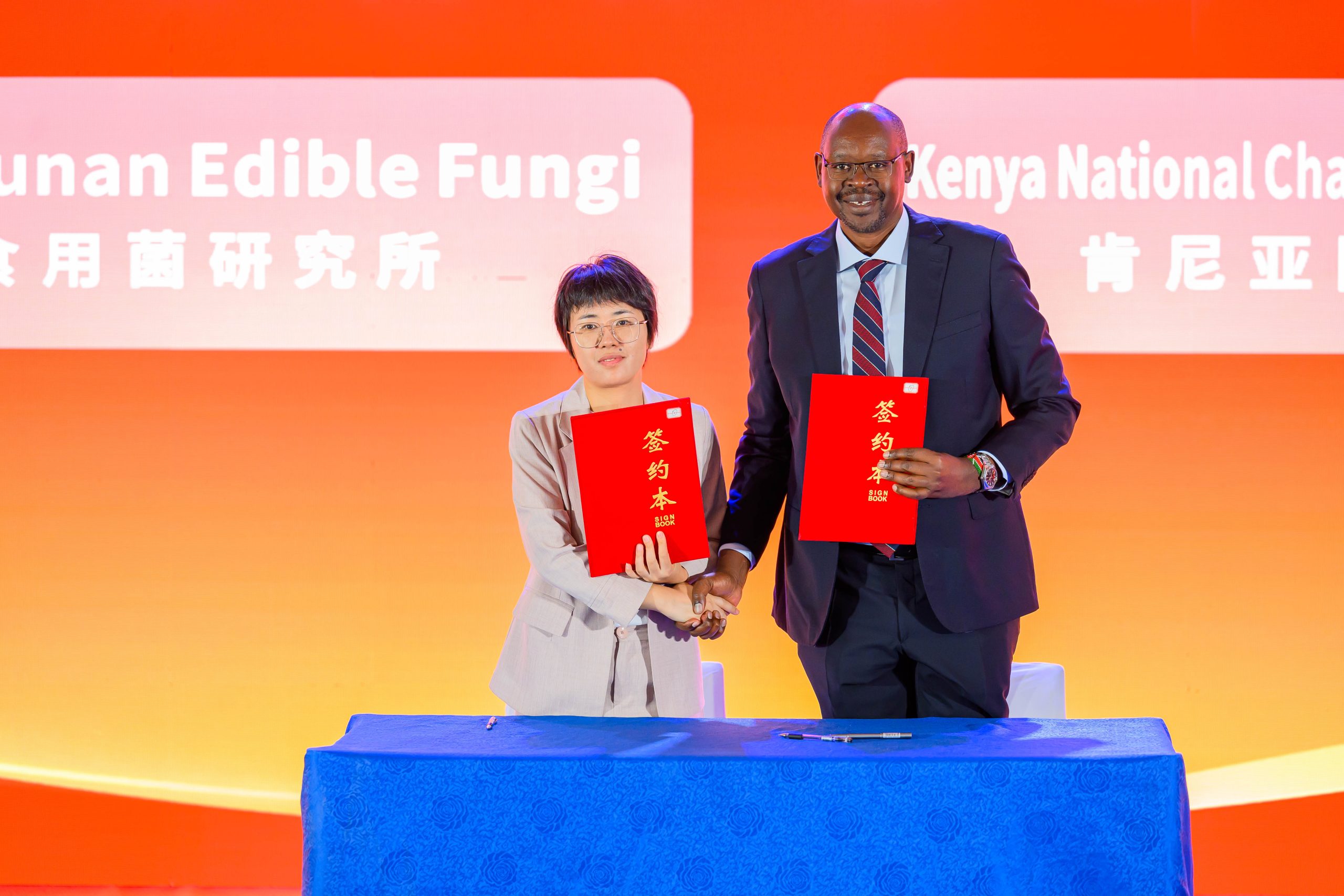

The Chamber Business Academy (CBA), under the Kenya National Chamber of Commerce & Industry (KNCCI), has officially signed a strategic Memorandum of Understanding (MoU) with the China-Africa Economic and Trade Promotion Council (CAPETPC) of Hunan Province, Changsha. This historic partnership establishes a framework for technical cooperation, capacity building, and technology transfer designed to accelerate the growth of a professional and market-oriented mushroom value chain across Kenya and the wider region.
The framework outlines clear roles for both entities over its three-year duration. The Chamber Business Academy (CBA) under KNCCI will spearhead comprehensive capacity-building initiatives, designing practical training programs in production, enterprise management, standards compliance, and market linkages. Concurrently, CAPETPC will facilitate access to Chinese agricultural experts, advanced production equipment, and research solutions, alongside fostering business matching between local stakeholders and Chinese investment partners. The collaboration spans technical training, introduction of sophisticated farming equipment, value addition, and investment matchmaking.
Speaking at the ceremony, KNCCI President Dr. Erick Rutto outlined the immense socioeconomic opportunities within the mushroom sector, emphasizing its capacity to solve critical challenges in food security, SME development, and agribusiness job creation.

Addressing the latent potential of the market, Dr. Rutto stated:
“Kenya’s mushroom sector has strong potential to support agribusiness development, job creation, food security, and SME growth; however, unlocking this requires strong technical training and professional market linkages.”
He further elaborated on what is needed to robustly support the regional value chain, adding:
“To build a truly sustainable and practical value chain, we must cooperate internationally to introduce suitable technologies, modern production methods, and shared market information that empowers our local producers.”
Dr. Henry Rotich, representing the Kenya Bureau of Standards (KEBS) as Director of Metrology and Testing, echoed the need for structural improvement within the industry. Dr. Rotich called on Kenyan farmers and processors to focus intensely on elevating and refining phytosanitary standards. He noted that strict compliance with safety, quality, and technical standards remains the single most critical bridge for Kenyan agricultural products to successfully penetrate and compete in the highly lucrative global market.
In immediate execution of this MoU, KNCCI through the Chamber Business Academy will launch an intensive, one-week professional training course on mushroom farming starting next week. Participants will be trained in oyster and white mushroom cultivation, mushroom physiology and ecology, nutritional and environmental requirements, simplified cultivation methods, pest and disease control, grading, preservation, packaging, export procedures and market trade.

Meanwhile KNCCI’s Chamber Business Academy and the Institute of Human Edible Fungihave also signed a MoU for strategic cooperation.
END
Editors Note
- According to the KNBS Economic Survey 2026, agriculture accounted for 23.2% of GDP in 2025, while the value of marketed agricultural production reached approximately KSh706 billion.
- Within this sector, mushroom production presents a strong but underdeveloped commercial opportunity.
- The most widely cited industry baseline estimates Kenya annual mushroom demand at approximately 1,200 tonnes, against domestic production of about 500 tonnes. This indicates a potential supply gap of approximately 700 tonnes annually. Although these figures require an updated national assessment, it still shows that domestic production is not meeting market demand.
- Demand exists among hotels, restaurants, supermarkets, food processors, institutions and households.
- Buyers require consistent volumes, good quality, proper grading, reliable packaging and predictable supply.









Leave A Comment